Industrial Machinery
Moving parts, service areas, electrical access, pinch hazards, and operating risks require a product-specific review of hazards, placement, surface, and maintenance procedure.

StikTec industrial identification guide
The purpose of a warning label is to alert people to a specific hazard, explain the possible consequence of exposure to that hazard, and communicate how the risk may be avoided. It gives a user a visible safety message at the point where a product, task, or component could create a foreseeable risk.
Warning labels can appear on machinery, consumer products, equipment, packaging, electrical panels, containers, and instructions. They support safety communication, but they do not replace safer design, guarding, training, supervision, or operating procedures. Product owners must confirm applicable regulations, standards, signal words, symbols, languages, tests, and final warning content with qualified safety, legal, or regulatory advisers.
Overview
A warning label is most useful when it reflects a real, product-specific hazard and appears where the intended user can see it in time. It may identify a hot surface, electrical energy, moving part, sharp edge, cleaning chemical, lifting point, restricted-use condition, or service risk. The message needs to fit the product, audience, language, and market.
For procurement and product teams, this distinction is important. The label supplier needs reliable inputs, but the underlying safety decision belongs with the product owner. A clear brief identifies the actual product version, the hazard location, the intended user, the approved wording, and the physical conditions that affect label construction. This reduces the chance that a familiar-looking warning sticker is applied to the wrong product or placed where it cannot be read.
Why warning labels matter
People may approach a machine, cabinet, package, or component without reading a manual first. A visible warning label can bring attention to a condition before a user operates, opens, touches, removes, adjusts, or services the item. Attention is not the same as protection, but it helps connect the user to the hazard-specific information that remains relevant.
A concise message can identify what is hazardous, what may happen, and what action is expected. For example, an equipment warning label can direct an operator to disconnect power before service, keep hands clear of moving parts, use specified protective equipment, or follow a product-owner-approved procedure. The final instruction must come from the responsible product team and qualified advisers.
Safety labels are not a substitute for training, lockout procedures, risk assessment, guarding, manuals, or supervision. Instead, they reinforce those controls at the product itself. This is useful when operators change shifts, maintenance work occurs later, packaging is separated from instructions, or a product is used in a different location from its original installation.
For OEM teams, consistent product warning labels help the same approved safety information appear across equipment families, product variants, replacement parts, and markets. Consistency should be managed carefully: identical artwork is not automatically suitable for every model, hazard location, language, or market.
| Purpose | Practical Role |
|---|---|
| Alert users | Draw attention before exposure to a hazard. |
| Identify risk | State the hazard or unsafe condition. |
| Explain consequence | Describe a possible injury or damage outcome. |
| Provide avoidance action | Tell users what to do or not do. |
| Reinforce instructions | Support manuals, training, and procedures. |
Effective safety communication
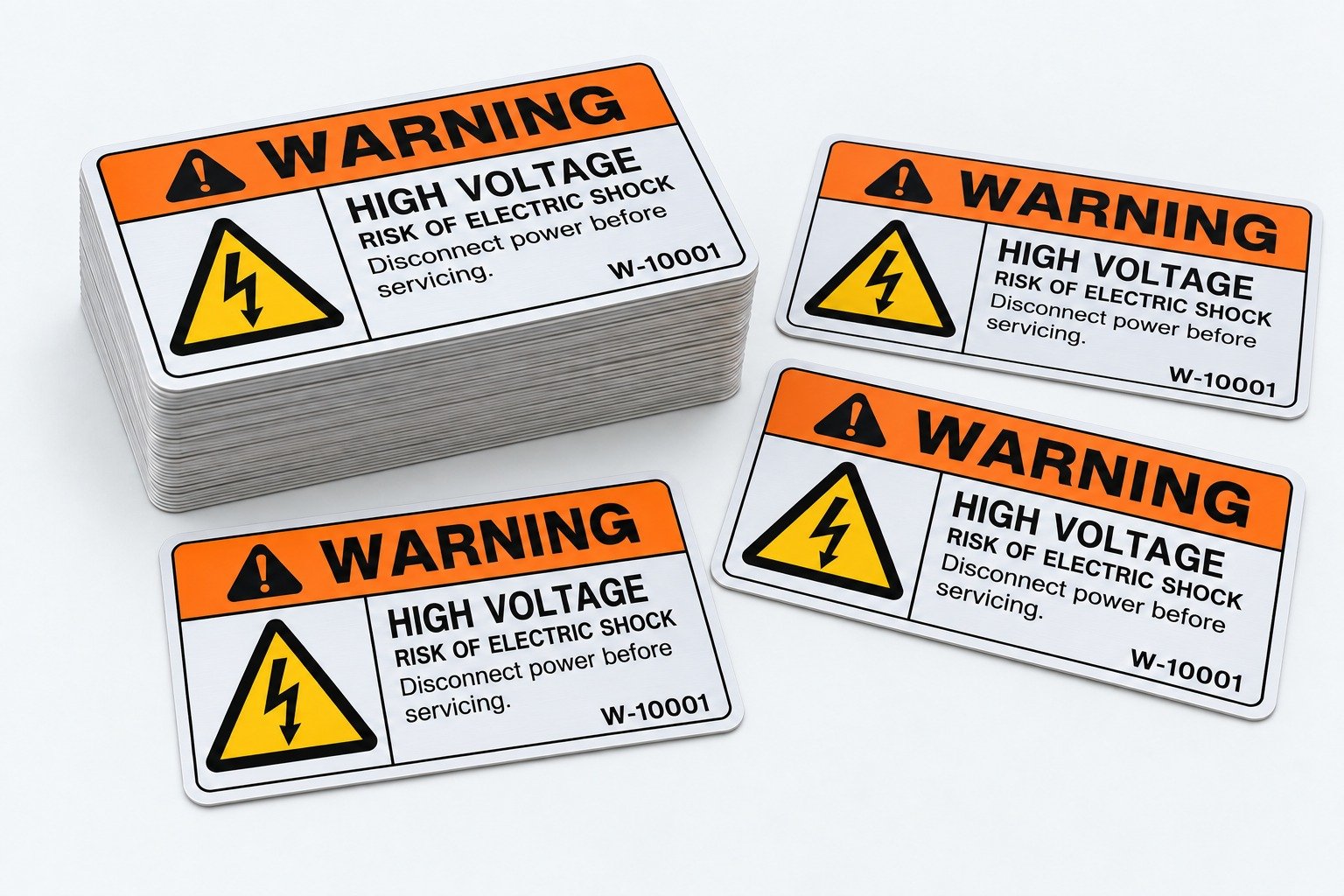
An effective warning label is based on a real product hazard, not a generic assumption. It identifies the hazard, communicates the possible consequence where appropriate, and states how the risk should be avoided. The product owner must confirm wording, symbols, signal words, language, placement, and applicable requirements before release.
Describe the specific condition the user needs to recognise: exposed energy, moving components, hot surfaces, sharp edges, hazardous substances, or a defined service condition. Broad statements can be overlooked because they do not tell the user what is different about this product or location.
Where the approved content calls for it, consequence information explains why the message matters. It should remain accurate and product-specific. Avoid inventing outcomes or copying text from a different product merely because the layout looks familiar.
Avoidance language gives an action: keep clear, disconnect power, wear protection, read instructions, secure the guard, or follow the approved procedure. The action needs to be realistic for the actual user and operating sequence.
People often scan a label quickly. Signal words, safety symbols, headings, contrast, and spacing can help organise the message. Visual hierarchy does not determine compliance by itself; it helps the approved content remain easy to notice and read.
Consider who will see the label, where the product will be sold, how close the user stands, and whether several languages are required. Product owners should confirm language, translation, symbol use, and market requirements with qualified advisers.
Effectiveness also depends on timing. A user should receive the message early enough to change a decision. A statement placed inside an electrical cabinet may assist a service technician, while a statement on an outer enclosure may be necessary before the cabinet is opened. Mapping the user journey helps separate these locations and keeps the safety information relevant to the action being taken.
| Label Element | Purpose | Buyer Must Confirm |
|---|---|---|
| Signal word | Draws attention to a safety message. | Applicable terminology and market requirements. |
| Safety symbol | Supports fast visual communication. | Required or approved symbol set. |
| Hazard statement | Identifies the specific risk. | Actual product hazard. |
| Consequence statement | Explains possible harm. | Product-specific risk information. |
| Avoidance statement | States required action. | Approved safety procedure. |
| Placement | Ensures users see the message. | Hazard location and user approach path. |
Common warning label elements
Warning label formats vary by product, market, industry, and applicable rules. No single visual format is universally compliant. A project may use a signal word, pictogram, text message, colour field, border, panel, or a combination of elements. The selected construction should follow the product owner's approved content and buyer-supplied requirements.
Terms such as DANGER, WARNING, CAUTION, NOTICE, and SAFETY INSTRUCTIONS may appear in recognised safety systems. Their meaning and selection must be confirmed for the project rather than chosen only for visual impact.
Symbols can support faster recognition, particularly where users speak different languages or have limited time to read. Confirm that any symbol set is appropriate, approved, and used with the required accompanying text.
Text should identify the risk and the required behaviour in a direct way. Label space, viewing distance, information density, and translation length can affect a readable layout.
Contrast can help separate critical text and symbols from a background. It should be evaluated in the intended lighting and against the actual product surface, not only on a bright digital screen.
Export markets, operators, distributors, and end users may require different languages. Confirm final wording, translation, readable size, and the order of languages before production.
Product identification
Not every product label is a warning label. A product can require multiple label types working together: a warning label communicates a safety-related hazard, while technical and identification labels help users identify the product, operate it, service it, or scan it within a workflow.
Separating these purposes helps buyers prepare clearer artwork. A rating plate may hold voltage or capacity data; a serial number plate may identify a specific unit; a barcode label may support scanning; and an instruction label may describe a control or operating sequence. Combining every message into one crowded label can reduce readability.
StikTec can produce several industrial labels in a coordinated visual system. The product owner remains responsible for defining and approving the final safety, technical, regulatory, and market-specific content.
| Label Type | Primary Purpose | Typical Information |
|---|---|---|
| Warning label | Communicate a safety-related hazard. | Hazard, consequence, avoidance action. |
| Rating plate | Identify technical product information. | Model, voltage, capacity, product data. |
| Serial number plate | Support unique identification. | Serial number, batch, model reference. |
| Barcode label | Support scanning and tracking. | Barcode, QR code, variable data. |
| Instruction label | Explain product operation. | Steps, directions, control information. |
| Security label | Support identification or tamper awareness. | Brand or tamper-related message. |
Warning label placement
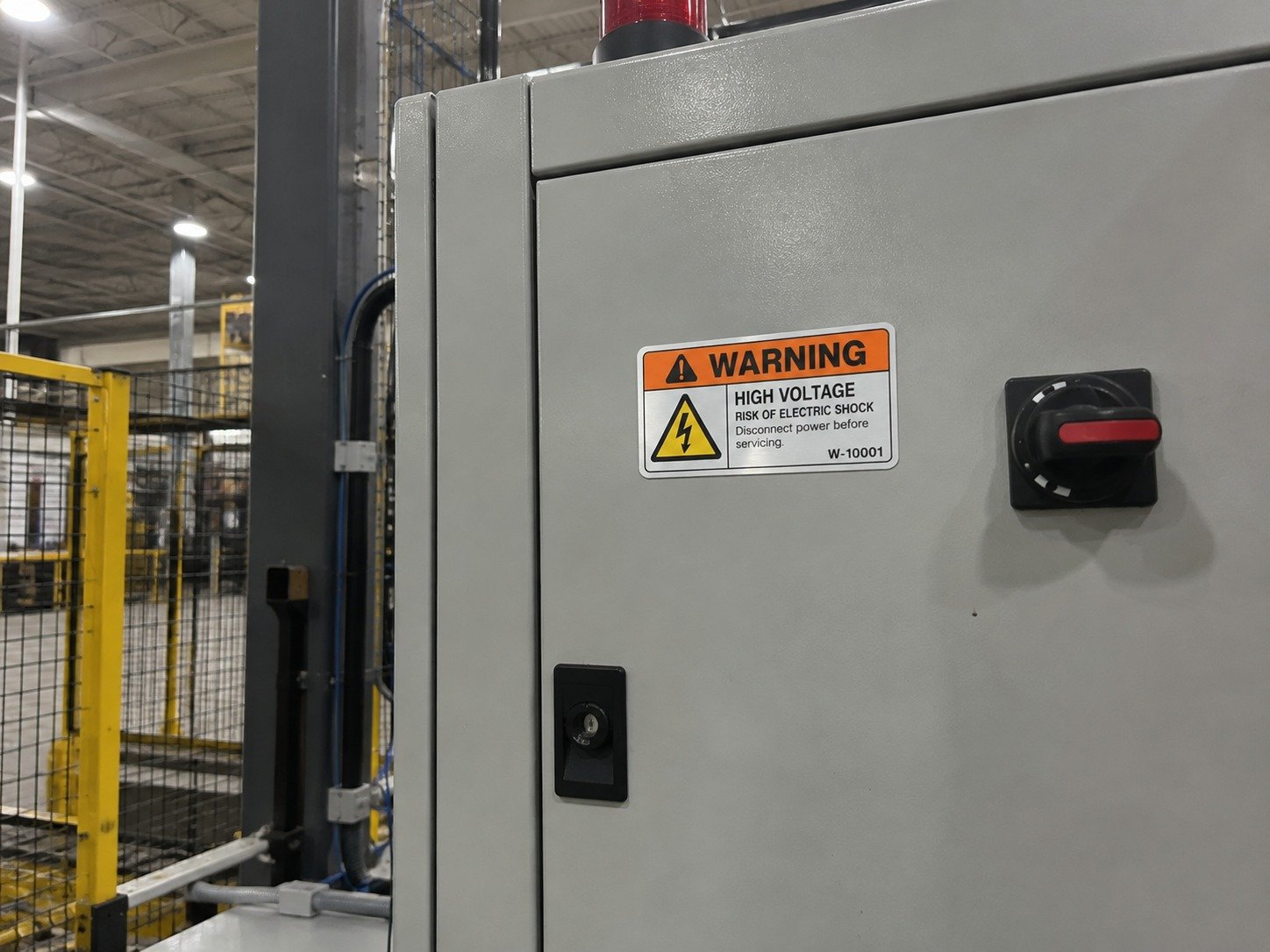
Users should see a warning label before encountering the relevant hazard. A message about a moving mechanism, electrical access point, hot surface, or service opening is more useful when it is clearly associated with that location. Placement must not create another hazard or obscure controls, vents, technical labels, or required product markings.
Review how an operator approaches, opens, loads, adjusts, cleans, or services the product. A label hidden by a cover, packaging, operating position, or adjacent component may not be seen when it matters. Different viewing directions can require repeated labels when the approved safety review calls for it.
Text and safety symbols need enough contrast and size for normal viewing conditions. Curved panels, recessed areas, glare, texture, shadow, and cleaning can affect what users can read. Use an actual product photo, drawing, or sample to review the mounting area.
Maintenance personnel may approach a product differently from operators. They may remove guards, open cabinets, reach access panels, or work around equipment that is not visible during normal operation. Service-related warning stickers should be considered during the product-owner safety review.

Materials and environmental considerations
Warning-label material should be selected for the actual application surface and environment. A visually similar label may behave differently on smooth metal, textured plastic, painted equipment, a curved container, a recessed control panel, or product packaging. Share real product information before material direction is finalised.
PVC can be considered for flexible label applications where surface, handling, and visual presentation need review. Its suitability must be assessed against the buyer's surface and environmental conditions.
PET can be considered where product and identification labels require a defined combination of information, handling, surface fit, and finish. It is not a universal solution for every exposure condition.
PC can be relevant for overlay and panel-related graphics where cutouts, windows, interface features, enclosure fit, and surface treatment form part of the brief.
Matte, glossy, lamination, UV treatment, embossing, and other finishes can support appearance, legibility, and handling. They should be selected for a defined project need. StikTec does not promise that a material will meet a specific durability, temperature, chemical, or outdoor requirement without project-specific review and validation.
Material selection should also consider how the label will be applied. A hand-applied warning sticker, a label supplied on a roll for a controlled process, and a graphic integrated into a panel assembly may have different backing, adhesive, cutting, and packing needs. Provide application photos where possible. They give more useful context than a material name alone and help identify curved areas, seams, recesses, or obstructions before artwork is finalised.
| Requirement | Information to Share |
|---|---|
| Surface | Smooth, curved, textured, painted, plastic, or metal. |
| Environment | Indoor, outdoor, humid, hot, cold, oily, or cleaned. |
| Exposure | Abrasion, chemicals, alcohol, UV, moisture, or handling. |
| Information | Warning text, symbol, barcode, or instructions. |
| Finish | Matte, glossy, laminated, UV-treated, or embossed. |
| Placement | Hazard location, viewing angle, and mounting area. |
Common warning label applications
Moving parts, service areas, electrical access, pinch hazards, and operating risks require a product-specific review of hazards, placement, surface, and maintenance procedure.
Equipment warning labels can identify electrical and service risks. Buyers should provide approved content and applicable requirements.

Use restrictions and foreseeable misuse should be reviewed against target users, markets, packaging, and product-owner hazard information.
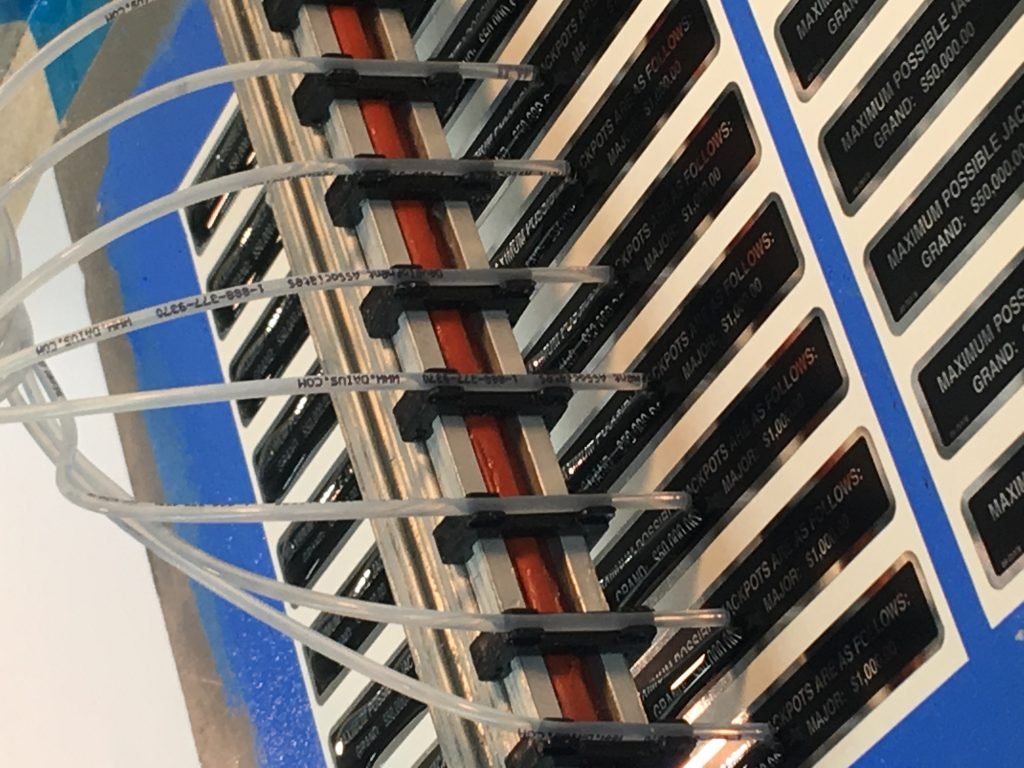
Regulated and specialist projects need buyer-supplied marking, documentation, and qualified compliance review before artwork is released.

Handling, storage, transport, and product hazards may need visible messages; classification and final approved content remain buyer responsibilities.
The same industrial label construction should not be assumed to fit every application. A warning sticker used beside a machine guard may need a different size, message hierarchy, placement drawing, and surface preparation from a warning on a shipping container or a consumer package. Use the final product context to review each label as part of the complete communication system.
| Application | Typical Warning Focus | Buyer Information Needed |
|---|---|---|
| Industrial machinery | Moving parts, service, electrical, pinch hazards. | Hazard location, procedures, surface conditions. |
| Electrical equipment | Electrical and service risks. | Approved content and applicable requirements. |
| Consumer products | Use restrictions and foreseeable misuse. | Target user, market, hazard review. |
| Medical projects | Product-specific safety communication. | Buyer-supplied marking and documentation requirements. |
| Packaging | Handling, storage, or product hazards. | Classification and final approved content. |
How to plan a warning label project
These steps help separate the buyer's approval responsibilities from the physical label-production discussion. A supplier can review dimensions, artwork readiness, material preferences, surface information, and supply format, but should not be assumed to provide legal review, certification, regulatory approval, or standard-compliant warning content without independently verified scope.
Version control matters in this workflow. Keep the approved text, symbol references, language versions, placement drawing, and artwork revision together. When a product changes, review whether a warning label also needs to change. A revised enclosure, new service door, changed control layout, or new destination market can affect where users see the message and which approved content belongs on the finished product.

Common mistakes to avoid
A label is not a replacement for safer design, a guard, a protective measure, or a qualified safety review. Start by asking whether the risk can be eliminated or controlled before relying on safety information.
Generic safety language can fail to explain what the user needs to notice at this specific location. Base content on the product owner’s actual hazard review and approved procedure.
Labels that are hidden, too far from the hazard, covered during use, or absent from a service access point may be missed. Review the product through the user's path.
A small digital proof may not reveal distance, glare, curvature, texture, or lighting issues. Review text size, contrast, symbol detail, and finish at the expected use condition.
Requirements vary by product, market, industry, and user. Confirm languages, content, symbols, signal words, and applicable requirements with qualified advisers.
| Potential Problem | Preventive Action |
|---|---|
| Warning does not address a real hazard | Base content on a product-specific safety review. |
| Label is overlooked | Improve relevance, visibility, clarity, and placement. |
| Label is unreadable | Review text size, contrast, finish, and viewing conditions. |
| Incorrect content | Obtain final wording from product owner and advisers. |
| Material mismatch | Review actual surface and environmental exposure. |
| Export-market issue | Confirm language and local requirements. |
Frequently asked questions
Its purpose is to call attention to a specific hazard, explain a possible consequence, and communicate an approved avoidance action before exposure. Warning labels support hazard communication at the product. They do not replace safer design, guards, training, procedures, or product-owner review.
Not every product needs the same warning label or any particular label format. Requirements vary by product, market, industry, hazards, and applicable rules. The product owner should confirm the need, content, placement, languages, and approvals with qualified safety, legal, or regulatory advisers.
Approved content may include a signal word, safety symbol, hazard statement, consequence statement, and avoidance action. The exact combination depends on the actual product risk and applicable requirements. Buyers should supply or approve final content rather than rely on a generic label.
They should be visible before the user encounters the related hazard and clearly associated with that location. Review normal operation, access panels, service points, packaging, and different approach paths. The product owner should confirm placement through its own safety and product review process.
These terms can have defined uses in recognised safety systems, but they should not be selected from appearance alone. Their meaning, signal-word level, accompanying symbol, and wording vary with the applicable system, market, and product. Confirm final use with qualified advisers.
Share the real surface, label size, mounting area, environment, cleaning process, handling, exposure, required information, and finish preference. PVC, PET, PC, and finishes may be considered for different uses, but the buyer must confirm application needs and any required testing or approvals.

Conclusion
Warning labels help users recognise specific hazards, understand possible consequences, and take approved avoidance actions. They work best as part of a safety system that first prioritises risk reduction through design and protective measures, then uses clear communication to address remaining risks.
For OEM and industrial buyers, the useful starting point is not a generic sticker. It is an approved product-specific brief: the hazard, audience, market, wording, symbols, placement, dimensions, surface, environment, and final artwork. That information lets the physical label construction be discussed with fewer assumptions.
StikTec supports custom warning labels, security labels, barcode labels, serial number plates, rating plates, asset tags, and industrial identification labels. For a custom warning-label project, provide final approved safety content, symbols, language, dimensions, quantity, placement location, surface material, application environment, and buyer-supplied compliance requirements.
Published: Author: StikTec Editorial TeamCategory: Nameplates & Identification

Discuss your warning label project
Share the product type, approved warning content, symbols, languages, dimensions, quantity, placement location, surface material, environment, and finish. Our team can then discuss the physical label requirements around your buyer-defined brief.
E-mail: stik@stiktec.com
Phone: +86 13026625634
WhatsApp: wa.link/l98mzc
Address: No. 69, West Shipai Avenue, Shipai Town, Dongguan City, Guangdong Province
Related Articles
Learn how asset tags, barcode labels, and equipment identifiers support asset records, audits, maintenance, and inventory control.
Understand how nameplates, rating plates, serial number plates, and technical identification labels support equipment information.
Review material, surface, environment, barcode, warning, identification, and finish considerations for industrial label projects.